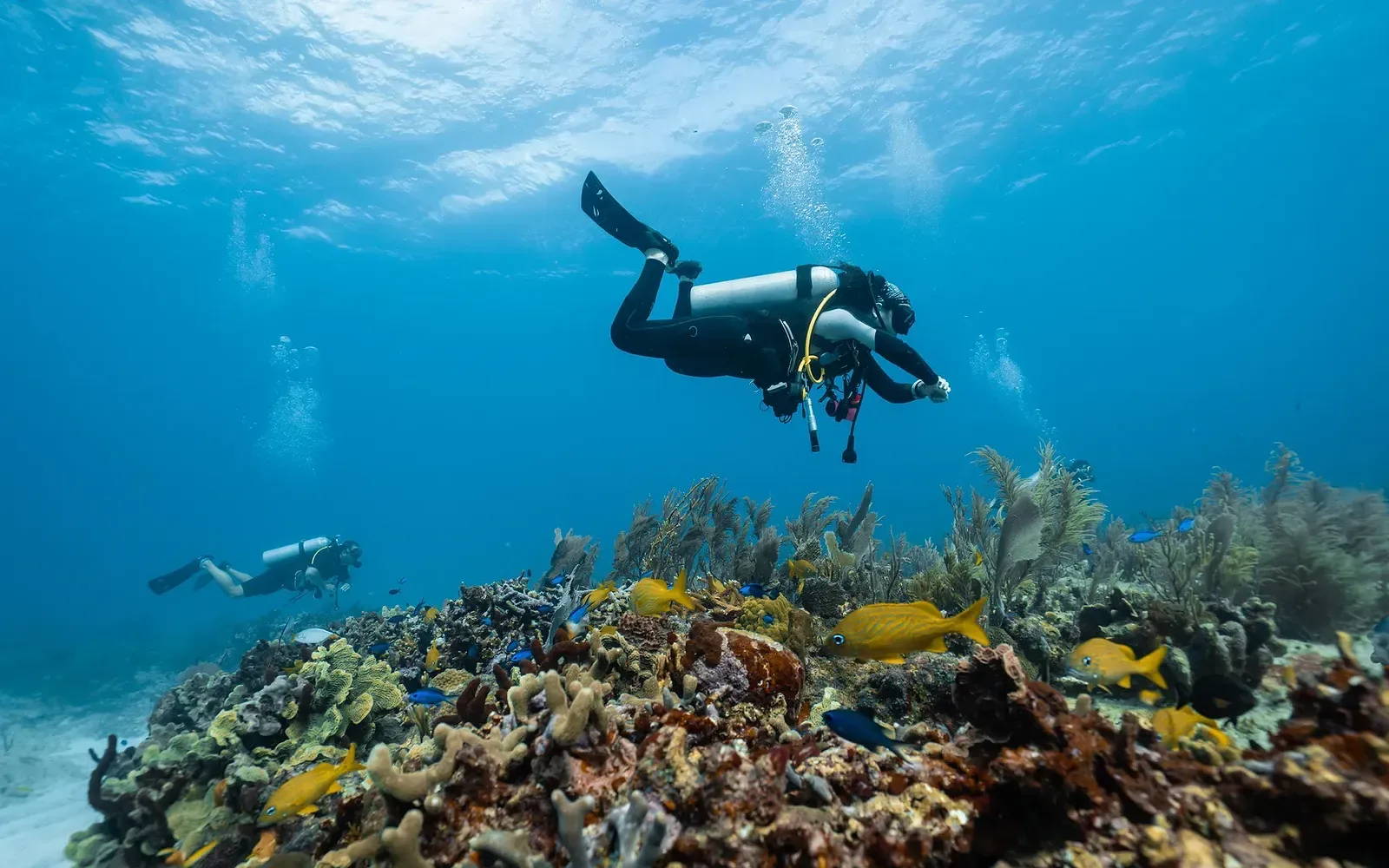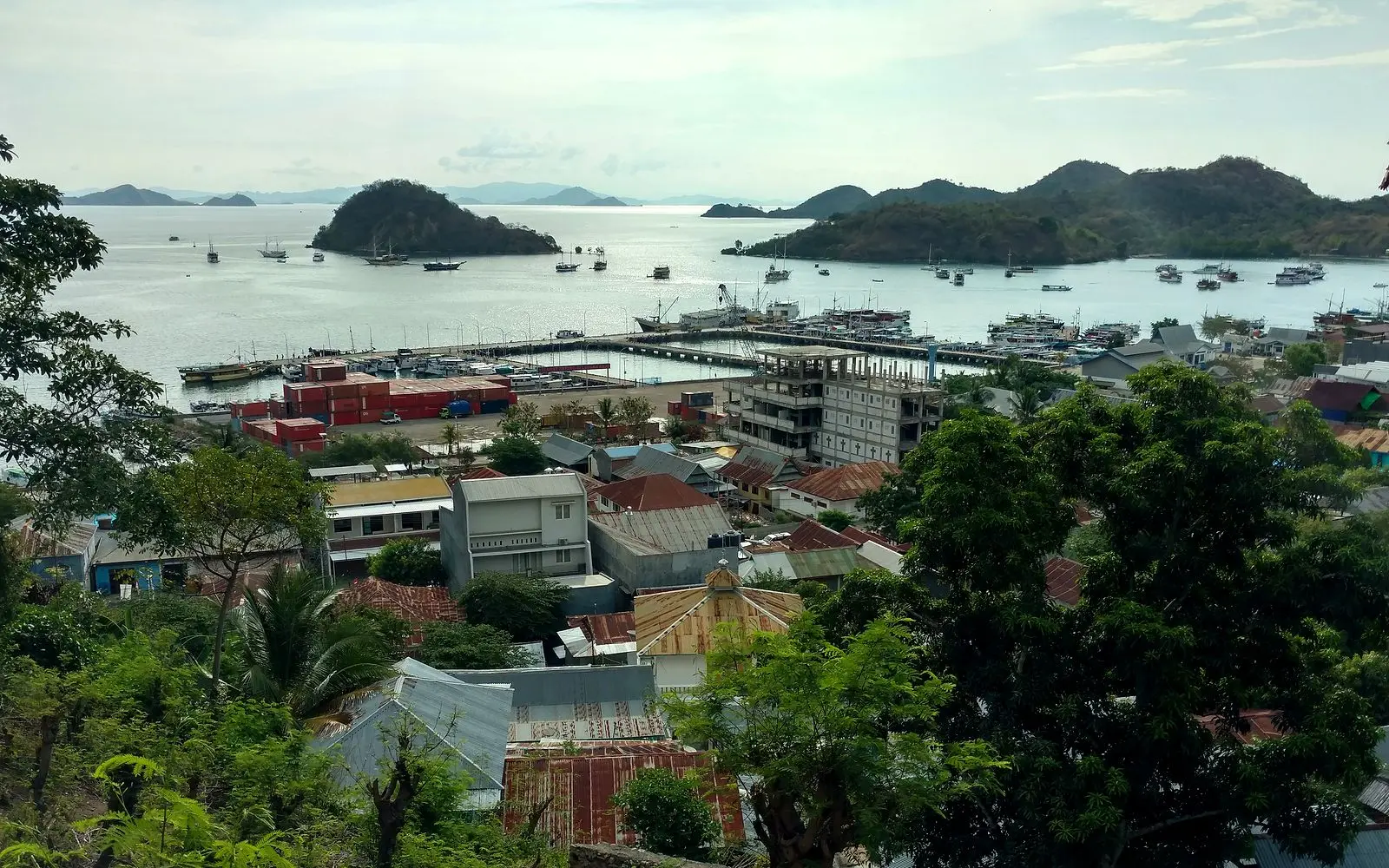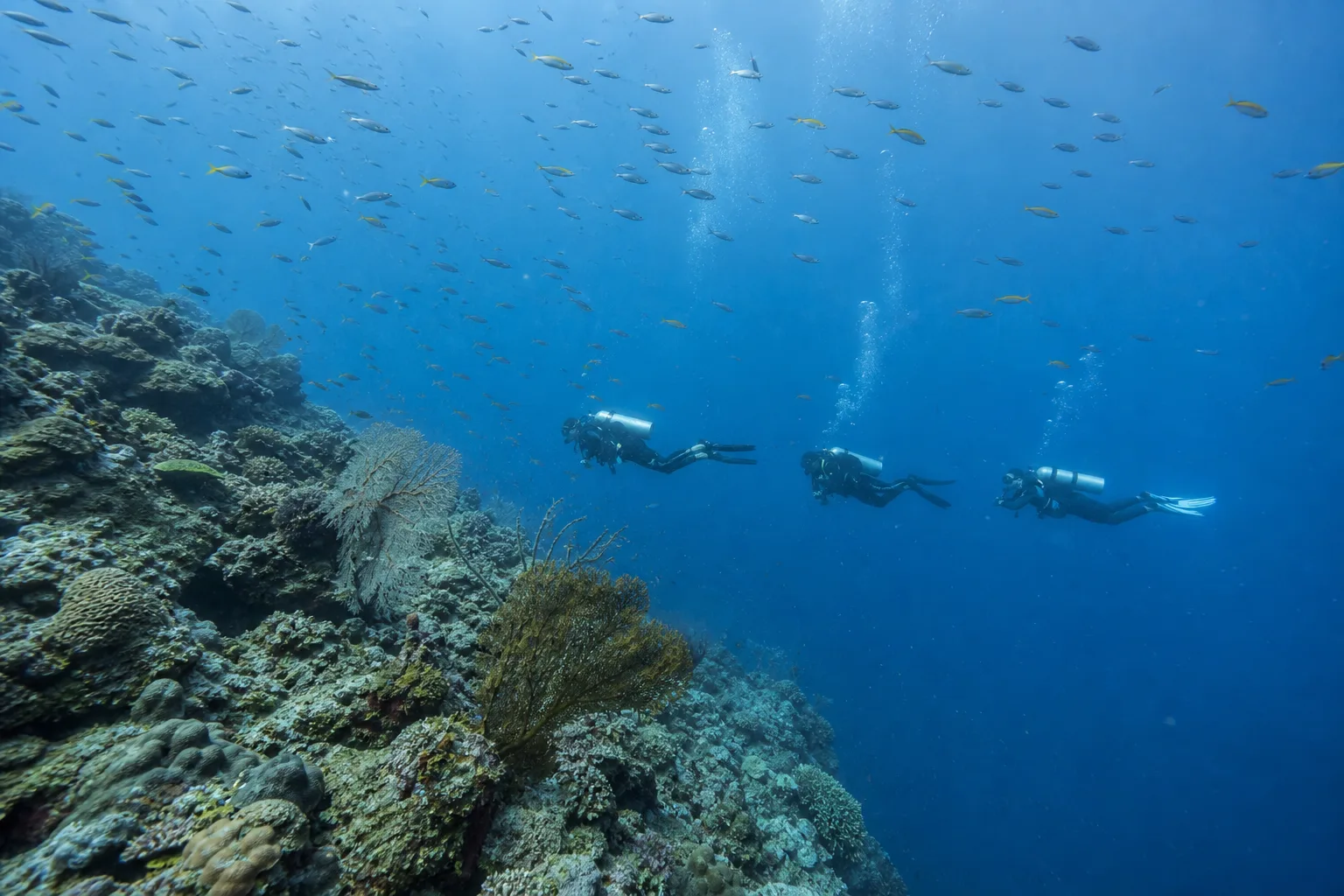
There is no easy way to fly from the United States to Raja Ampat, and anyone telling you otherwise is selling something. Sorong, the gateway city, takes no international flights at all. From most American cities you are looking at three flights minimum, usually four, spread across 32 to 40 hours of elapsed travel, crossing the international date line and finishing on a domestic Indonesian carrier that departs at an hour no reasonable person would choose. We say this plainly because the single most common planning mistake we see from North American guests is treating the last leg as a formality.
The good news is that the route is genuinely solvable, and thousands of American divers do it every season without drama. It just requires deciding two things properly: which Asian hub you cross the Pacific to, and where you spend the compulsory night inside Indonesia. Get those right and the journey becomes long but unremarkable. Get them wrong and you are the person watching your Indonesia liveaboard sail without you. This guide covers the realistic routings from both American coasts, what each leg costs in 2026, the two overnight strategies and which we recommend, baggage rules that catch divers out, visa mechanics for US passport holders, and the return journey, which is the part that needs the most care because of the no-fly interval after a week of diving.
The shape of the journey
Every American routing follows the same four-stage structure, and it helps to hold it in your head as four separate problems rather than one itinerary.
Stage one is the transpacific crossing, from your home airport to an Asian gateway. In practice that means Tokyo, Seoul, Taipei, Hong Kong, Singapore, or Doha and Dubai if you route west instead. This is the expensive leg and the one you should book first, because everything downstream depends on when it lands.
Stage two gets you into Indonesia, almost always to Jakarta and occasionally to Denpasar in Bali or Makassar. Stage three is the domestic flight to Sorong, and this is the leg that dictates everything. Stage four is the short transfer from Sorong airport to the harbour, which for liveaboard guests is usually handled by the boat and takes about twenty minutes. The detailed mechanics of stages three and four, including the ferry option to Waisai for land-based travellers, are covered in our general guide to how to get to Raja Ampat. This article concentrates on the part that guide does not cover: getting from North America to the start of it.
West Coast routings
From Los Angeles, San Francisco, Seattle or Vancouver you have the best options available to any American diver, because the transpacific flight is direct and the total elapsed time can be kept near the low end of the range.
The cleanest pattern is a single Pacific crossing to a major Asian hub, then one flight into Jakarta. Los Angeles to Tokyo Haneda runs about 11 to 12 hours, Tokyo to Jakarta another 7 to 8. Seoul works identically and often prices lower. Taipei is frequently the cheapest of the three and adds nothing meaningful in time. Singapore is the most comfortable option and has the additional advantage of putting you one short hop from Jakarta with many daily departures, which gives you resilience if something slips.
Realistic total from the West Coast, door to boat, is 32 to 36 hours including the overnight in Indonesia. Economy fares for the round trip to Sorong booked two to three months out typically land between US$1,300 and US$1,900 in low season and US$1,700 to US$2,400 around the December to February peak, which is unfortunately exactly when Raja Ampat dives best. Premium economy runs roughly 60 to 90 percent above those figures and, on a 12-hour Pacific leg followed by a week of three-dive days, a number of our repeat guests consider it money well spent.
East Coast and Midwest routings
From New York, Boston, Washington, Atlanta, Chicago or Dallas you have a genuine decision to make, because west and east routings are competitive.
Going west across the Pacific means a domestic or long transcontinental leg to the West Coast, then the pattern above. From JFK this often means Tokyo or Seoul with a connection, and total elapsed time lands around 36 to 40 hours.
Going east via the Gulf is frequently the better choice from the eastern seaboard. New York to Doha or Dubai is roughly 12 to 13 hours, then Doha to Jakarta about 8 to 9. Emirates and Qatar both feed Jakarta well, the connections are engineered for exactly this kind of transfer, and the baggage allowances tend to be more generous than American carriers on the transpacific routes, which matters when you are carrying regulators and a camera housing. Total elapsed time is similar to the Pacific option, around 34 to 38 hours, but the layover experience is usually better.
Our informal observation from years of guest arrivals: East Coast divers who route via the Gulf turn up in noticeably better shape than those who chain three American and Asian carriers together. The number of connections matters more to how you feel than the total hours do.
The overnight decision: Jakarta or Sorong
This is the most consequential choice on the whole trip, and it gets less thought than it deserves. Flights from Jakarta to Sorong are limited and mostly depart very early or overnight. That means you cannot realistically arrive from America and connect straight through. You will sleep somewhere. The question is where.

Option one: overnight in Jakarta. Land at Soekarno-Hatta in the evening, sleep at an airport hotel, take the early morning flight to Sorong. There are hotels connected to the terminal and several more a short shuttle away. The advantage is that you break the long-haul journey at the point of maximum fatigue and start the domestic leg with some sleep behind you. The disadvantage is an early alarm, often 4am, for a flight that may route via Makassar.
Option two: overnight in Sorong. Take a late or red-eye flight out of Jakarta, arrive in Sorong in the morning, and spend the day and night there before boarding. Sorong has perfectly adequate business hotels. This is the option we quietly prefer for guests coming from North America, for one reason: it puts your buffer on the far side of the fragile connection rather than in front of it. If your Pacific flight is delayed, you still have a whole day of margin to reach Sorong. If you had planned to overnight in Jakarta and arrive in Sorong on boarding morning, a delay anywhere upstream can cost you the trip.
Our recommendation, and it is a firm one for anyone flying from the United States: arrive in Sorong a full day before your boat departs. Not the same morning. The extra hotel night costs less than a hundred dollars and it removes the single largest risk in the entire itinerary. We covered a case in our geography guide where a guest missed the Sorong connection by twenty minutes and lost a full day, because the next useful flight was the following morning. That is the pattern, and it is why this paragraph exists.
What the whole journey costs in 2026
Costs vary with season and how far ahead you book, but these bands reflect what our American guests actually report paying.
| Item | Typical cost | Notes |
|---|---|---|
| US to Jakarta, round trip economy | US$1,000 to US$1,700 | Higher from the East Coast in peak season |
| Jakarta to Sorong, round trip | US$250 to US$400 | Book separately; often cheaper than through-ticketing |
| Airport hotel, Jakarta or Sorong | US$45 to US$110 per night | Budget two nights across the round trip |
| Sorong airport to harbour transfer | Usually included | Confirm with your operator |
| Raja Ampat marine park permit | Around US$65 equivalent | Paid in rupiah; funds local conservation |
| Indonesian visa on arrival | Around US$35 equivalent | Extendable once for the same amount |
All in, budget US$1,600 to US$2,600 for the travel component alone before the trip itself. That is a significant number and worth knowing early, because it changes the calculus on trip length. If you are spending 70 hours and two thousand dollars in transit, a seven-night itinerary starts to look short. This is the main reason we push American guests toward ten nights or more if their schedule permits, and toward Misool and the north rather than a purely central route.
Booking it as one ticket or several
A recurring question, and the answer involves a genuine trade-off.
One through-ticket to Sorong gives you protection: if a delay breaks your connection, the airline owes you a rebooking. The cost is flexibility and often money, since through-fares to secondary Indonesian cities on foreign carriers are frequently poor value, and some airline combinations simply cannot be ticketed together.
Separate tickets for the international portion and the Indonesian domestic portion usually save a few hundred dollars and let you pick the domestic flight you actually want. The risk is that a missed connection is entirely your problem. This is precisely why the extra day in Sorong matters: with a full day of buffer, separate tickets become low-risk, and you capture the savings without the exposure. That is what most experienced Indonesia divers do.
Whichever way you go, book the domestic leg on a carrier your operator recognises, and send your flight details to the boat as soon as you have them. Every competent operator tracks guest arrivals and will tell you if a routing worries them. We have talked more than one guest out of a 90-minute connection in Jakarta.
Baggage: where American divers get caught
Your transpacific ticket probably allows two checked bags of 23 kilograms each, or one generous allowance in premium cabins. Your Indonesian domestic flight to Sorong almost certainly does not. Domestic allowances on the Sorong routes commonly sit around 20 kilograms in economy, sometimes less on the smaller aircraft, and excess is charged per kilogram at the counter in rupiah.
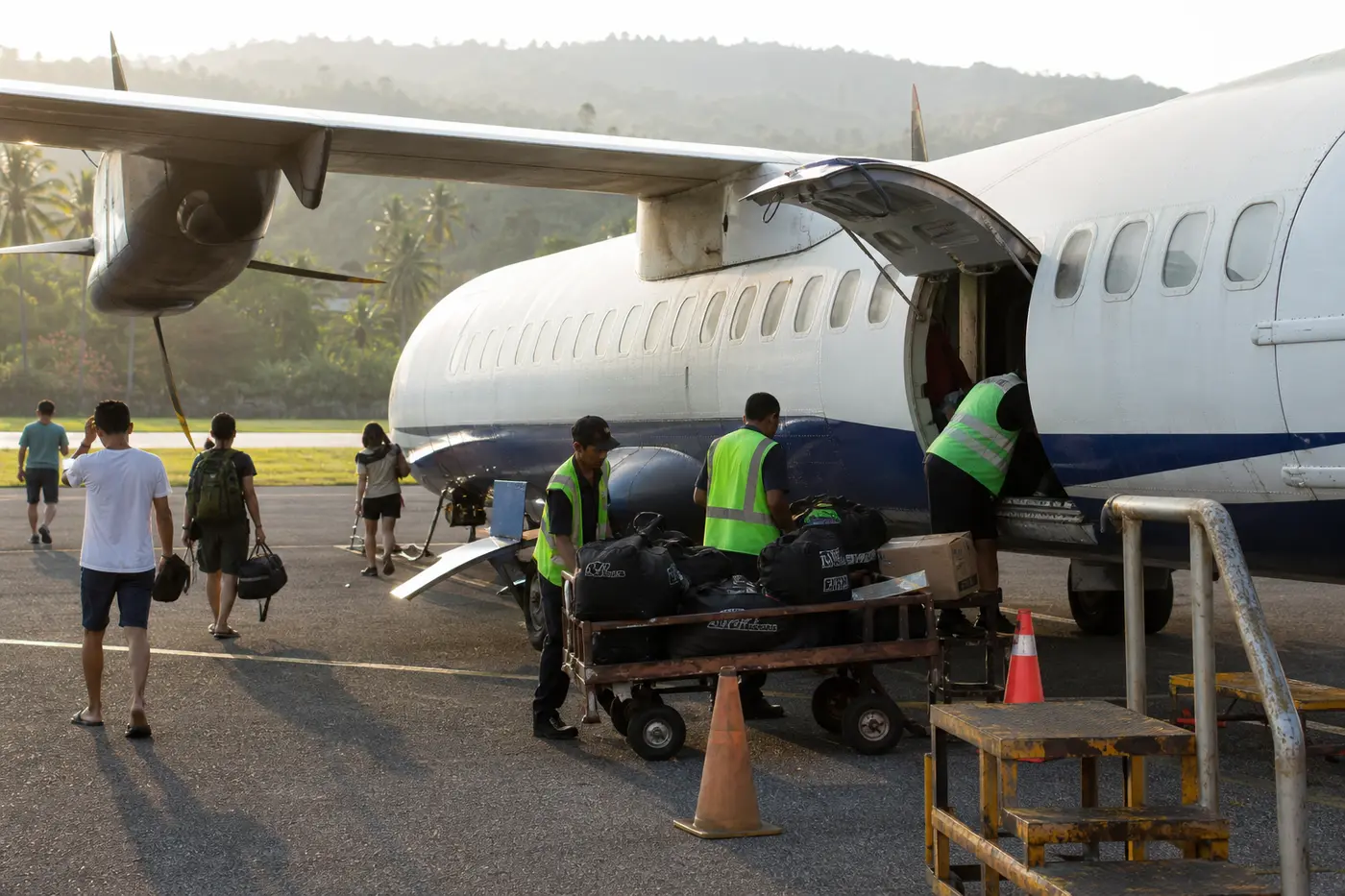
A full dive kit with regulators, a BCD, wetsuit, fins, computer, torches and a camera system runs 22 to 30 kilograms without trying. The arithmetic does not work by accident, so plan it deliberately:
- Buy the extra domestic allowance online in advance. It is materially cheaper than paying at the airport and takes two minutes on the carrier's site.
- Carry regulators, computer, camera bodies and lenses in your cabin bag. This protects the expensive and hard-to-replace items, and it moves weight off your checked allowance. Nobody in Sorong is selling you a replacement regulator.
- Leave the BCD and wetsuit at home if your boat rents decent ones. Many do, ours included. A rented BCD is a perfectly good BCD; a rented mask is a miserable mask. Bring your own mask and computer, rent the bulk.
- Use a soft duffel rather than a hard case. Cabins and gear stations are tight, and soft bags stow flat.
- Assume nothing about torch batteries. Lithium rules are enforced inconsistently across Indonesian domestic carriers, so keep them in your carry-on and within the standard watt-hour limits.
Our full liveaboard packing list for Indonesia goes through this in detail, including the items people consistently forget. One more genuinely useful habit: pack a full day of dive-critical items in your carry-on, meaning mask, computer, prescription anything, and swimwear. Bags do occasionally arrive a flight late on the Sorong routes. Guests who packed a mask in hand luggage have started their trip on time; guests who did not have sat out the first morning.
Visa and entry for US passport holders
American citizens can enter Indonesia on a visa on arrival for tourism, currently valid for 30 days and extendable once by a further 30. The fee sits around the equivalent of US$35 and is payable on arrival, or in advance through the official electronic system, which is worth doing because it shortens the queue considerably after a 30-hour journey.
Three practical requirements catch people out. Your passport needs at least six months of validity beyond your arrival date, and airlines do check this at the American departure gate. You may be asked for proof of onward or return travel. And Indonesia has at times required an electronic customs declaration submitted shortly before arrival, which is straightforward but easier done on hotel wifi than while shuffling toward an immigration desk. Rules change, so verify against the official Indonesian immigration source close to departure rather than trusting any blog, including this one.
There is no separate permit to enter Raja Ampat itself beyond the marine park entrance fee, which your operator will normally arrange or collect. Keep the tag or receipt; rangers do occasionally check it, and it is valid for a year.
The date line, jet lag and arriving able to dive
Flying west across the Pacific you lose a calendar day, so a Monday evening departure from Los Angeles delivers you into Jakarta on Wednesday morning. Build your itinerary from the boarding date backwards and count the days carefully, because miscounting the date line is a real and recurring error.
Raja Ampat runs at UTC+9, which is 16 hours ahead of Pacific time and 13 ahead of Eastern. That is close to a maximum possible shift, and there is no clever trick to defeat it. What does work, in our observation of several hundred American arrivals: sleep on the transpacific leg regardless of the local hour, get daylight and a walk on your buffer day in Sorong, eat on local mealtimes from the moment you land in Asia, and go easy on alcohol for the first 48 hours. Dehydration compounds both jet lag and, more importantly, decompression risk.
Which is the real argument for the buffer day. A diver who has been awake for 30 hours, is 16 time zones out of phase and dehydrated from three flights is not a diver who should be doing a negative entry into current on a first dive. Your first day in Raja Ampat will be a checkout dive followed by two or three more, and the difference between doing it rested and doing it wrecked is not subtle.
The journey home needs more planning than the journey out
This is the section most travel guides skip, and it is the one where mistakes carry actual medical risk rather than mere inconvenience.
You will finish your last dive, sail back toward Sorong, and disembark. From that moment you need to respect the no-fly interval. Standard guidance after multiple days of repetitive diving is a minimum of 18 hours before flying, with 24 hours the conservative and widely preferred figure. Your flight out of Sorong is not a short hop home; it is the first of three or four flights that will keep you at altitude repeatedly over 40 hours. We wrote up the full reasoning in our guide to flying after diving, and the summary is that this is the one interval on the trip worth being boring about.
In practice this means most itineraries end with a final morning of no diving, disembarkation, and a night in Sorong or Jakarta before flying. Some guests treat that as dead time. We would suggest treating it as the cheapest insurance on the trip. Decompression sickness developing over the Pacific, six hours from a chamber, is a genuinely bad situation, and the Papuan region's medical infrastructure is thin enough that prevention is the whole strategy.
Flying east across the date line you regain the day you lost, so a Saturday departure from Jakarta typically gets you home Saturday evening despite 30-plus hours of travel. It feels strange and it wrecks most people for a couple of days. Do not schedule anything important for the Monday.
A routing that works, start to finish
Here is a real-shape itinerary for a ten-night trip departing Sorong on a Saturday, from the West Coast. Adjust the front end for your own city.
Wednesday evening: depart Los Angeles for Tokyo or Singapore. Friday morning: arrive at the Asian hub, connect to Jakarta, land Friday evening, sleep at an airport hotel. Saturday early: fly Jakarta to Sorong, arriving late morning. Hotel in Sorong, walk, eat, sleep properly. Sunday: board. That gives a full day of buffer and one genuinely restorative night before the first dive.
On the way back, with the boat returning to Sorong on a Wednesday morning: disembark Wednesday, stay in Sorong that night, fly to Jakarta Thursday morning, connect onward Thursday evening. That produces roughly 24 hours between the last dive and the first flight, which is the interval you want.
Compress that itinerary by two days, which people regularly try to do, and you get a diver arriving on boarding morning after 35 hours of travel and flying home eight hours after their last dive. Both ends become risky for no real saving, because the flights are the expensive part, not the hotels.
Is it worth it from the United States
Honestly, that depends on who you are as a diver, and we would rather say so than pretend otherwise. If you have 50 logged dives, are comfortable in current, and can commit ten nights, then yes, and the travel becomes a footnote by day three. Raja Ampat holds more coral species than anywhere measured on Earth and the fish density on a good Dampier Strait dive is genuinely difficult to describe to people who have not seen it.
If you are newly certified, or can only spare a week door to door, we would gently point you toward Komodo instead, and our honest assessment of whether beginners can do a liveaboard is worth reading first. It is a one-hour flight from Bali rather than a full extra day, the sites sit closer together, and it delivers mantas and drift diving of a very high standard for meaningfully less money and travel. That advice costs us bookings on the Raja Ampat boats and we give it anyway, because a diver who arrives under-prepared for Raja Ampat's currents does not enjoy it, and that serves nobody.
If you have decided, the next two things to settle are when to go, since the season runs roughly October to April and the peak sits in the northern winter, and where exactly you are actually going once you get there. Our month-by-month breakdown of the best time to visit Raja Ampat handles the first, and where Raja Ampat is covers the geography that determines the second.