Ask anyone who has spent a week on an Indonesia liveaboard what they remember most, and the boat itself comes up surprisingly often, sometimes before the mantas. There is a reason for that. The wooden sailing yachts that carry most of Indonesia's dive cruises are phinisi: hand-built, two-masted vessels from a boatbuilding tradition so old and so distinctive that UNESCO added it to the list of Intangible Cultural Heritage of Humanity in 2017. You are not sleeping in a floating hotel. You are sleeping inside a craft that a village in South Sulawesi has been perfecting, hull by hull, for generations.
This guide explains what a phinisi actually is, where and how these boats are built (still on open beaches, still largely without blueprints), how a cargo schooner tradition turned into the backbone of Indonesian dive cruising, and what the difference means for you as a guest: how the boat moves, how it sounds, why the deck space is so generous, and what to look for when you are choosing between a traditional hull and a modern luxury liveaboard. By the end you will be able to tell a genuine phinisi from a marketing photo, and you will probably want to sail on one.
What "phinisi" actually means
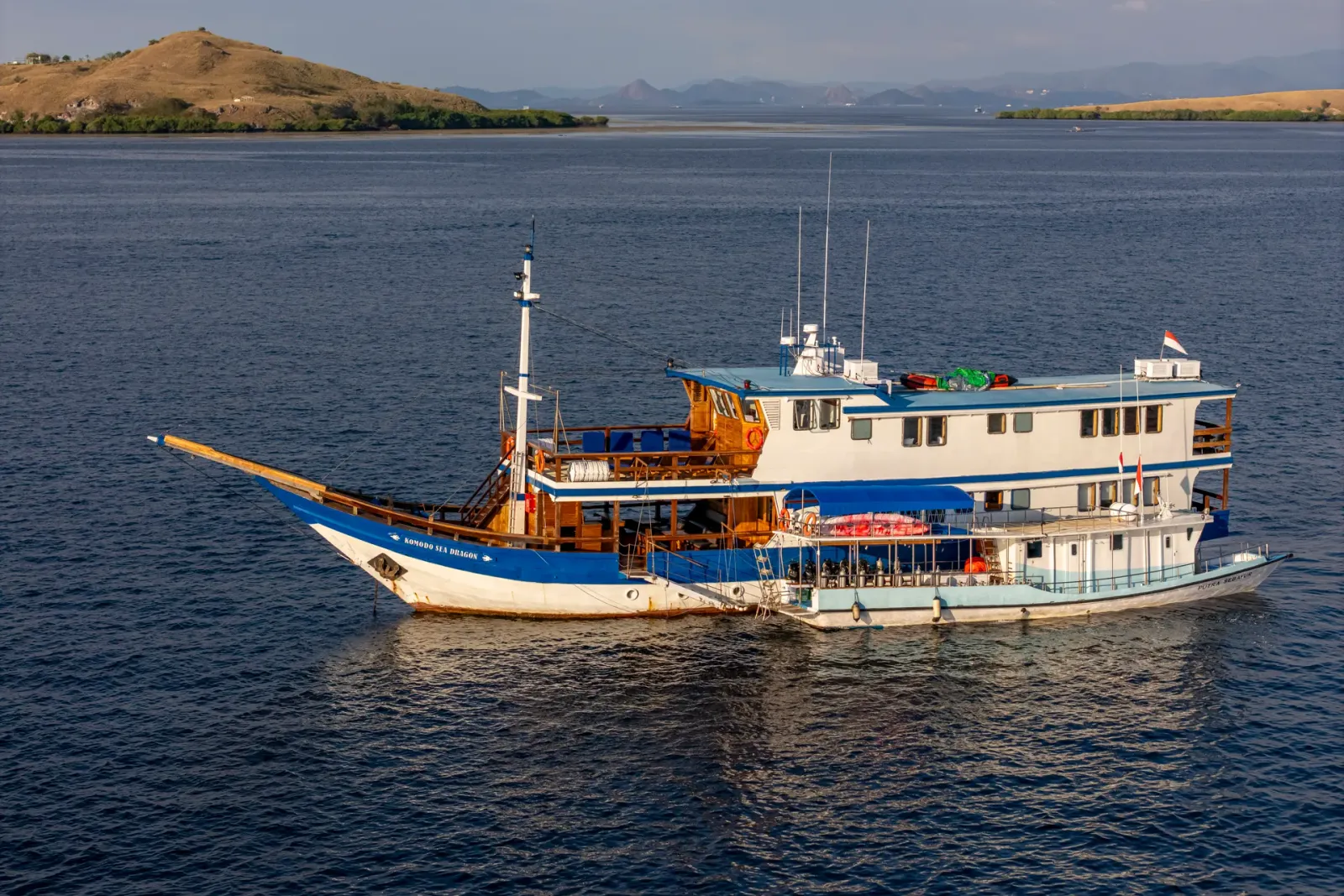
Strictly speaking, phinisi (also spelled pinisi) does not describe a hull at all. It describes a rig: a two-masted layout carrying seven or eight sails, with gaff-rigged mainsails, three jibs running to a long bowsprit, and topsails above. Naval historians would file it somewhere between a schooner and a ketch. The hull underneath has its own name, palari, a fast-lined displacement hull developed by the Konjo-speaking boatbuilders of South Sulawesi. Over the last century the two words merged in everyday use, and today "phinisi" means the whole boat: the sweeping sheer line, the raised aft deck, the twin masts, the bowsprit reaching out over the anchor.
The people behind it are the Bugis and Makassar of South Sulawesi, together with the Konjo builders of the Bulukumba regency, seafaring cultures with a maritime record stretching back many centuries. Bugis traders sailed these waters to Singapore, northern Australia and everywhere between, carrying timber, rice, copra and spices. Their reputation travelled further than their cargo; one popular (and probably too tidy) etymology claims European sailors' tales of "Bugis men" gave English the word bogeyman. The boats themselves are documented in something close to their modern form from the early 1900s, when local builders blended European schooner rigging with hull lines they had been refining since long before anyone was writing any of it down.
Where phinisi are born: the beach shipyards of Bulukumba
Nearly every phinisi afloat today, including the polished charter yachts with air-conditioned suites, began as raw timber on a beach in one of two villages: Tana Beru or Ara, in the Bulukumba regency at the southern tip of Sulawesi. There are no dry docks, no cranes, no drawing offices. Hulls the size of small ferries take shape in the open air, propped on wooden scaffolding a few metres above the high-tide line, built by carpenters called panrita lopi, masters of boats, who work from memory and proportion rather than plans.
The construction sequence would make a European naval architect protest. The planking goes on first, edge-joined with long wooden dowels, and the ribs are fitted afterwards into the finished shell, the reverse of Western practice. Keels are traditionally cut from ulin, Bornean ironwood so dense it barely floats; ribs from bitti, a local hardwood the builders trust for its natural curves; decks and superstructure from teak. A 40-metre hull takes roughly two to four years from keel-laying to launch, depending on the size of the crew and, in our experience, on the timber market that year. Ceremony runs through the whole process: an offering when the keel is laid, prayers at the joining of the stem, and a launch day when the entire village turns out to haul the hull down greased timbers into the sea. Some of it usually takes several attempts. Nobody minds.
From spice cargo to dive deck: a short history
For most of the twentieth century, phinisi were working boats. Hundreds of them moved timber from Kalimantan, rice and cement between islands, and copra out of the eastern archipelago, sailing engineless on the monsoon winds well into the 1970s. Then two things happened. Engines arrived, and the rigs shrank; the classic pure-sail phinisi gave way to the motorised PLM (perahu layar motor, "motor sailing boat") that kept the masts but did most of its miles under diesel. And road and container transport slowly ate the cargo trade that the boats were built for.
The fleet could have died there, the way most of the world's working sail did. Instead, in the 1990s and 2000s, a handful of expedition and dive operators realised that a hull designed to carry 200 tonnes of timber through open ocean was, give or take a refit, a spectacular platform for carrying twenty guests through the Coral Triangle. The raised aft deck became a lounge. The cargo hold became en-suite cabins. The long foredeck, once stacked with cargo, turned out to be the best sunset seat in Indonesia. Today the order books at Tana Beru are filled not with freighters but with charter yachts, and the boatbuilding tradition UNESCO recognised in 2017 is being kept alive, in large part, by diving and cruising tourism. Guests sometimes ask us whether tourism has spoiled the tradition. Our honest answer is that tourism is currently funding it.
The UNESCO listing: what was actually recognised
In December 2017, UNESCO inscribed "Pinisi, the art of boatbuilding in South Sulawesi" on its Representative List of the Intangible Cultural Heritage of Humanity. It is worth being precise about what that means, because the marketing around it is often sloppy. UNESCO did not certify any particular boat, and there is no such thing as a "UNESCO-listed phinisi" for sale or charter. What was recognised is the knowledge system: the skills of the panrita lopi, the rituals that accompany construction, the apprenticeship chain through which a builder's son or nephew learns to eyeball a hull's lines without ever drawing them, and the social fabric of the Ara and Tana Beru shipyard communities.
The listing matters for a less romantic reason too. Intangible heritage gets listed when it is culturally significant and when its transmission is under some pressure, and both are true here. Young people in Bulukumba have other options now, ironwood is harder and more expensive to source than it was a generation ago, and a tradition that lives in memory rather than blueprints is only ever one untaught generation from being lost. The charter fleet is, in a very direct way, the tradition's current patron: every new build commissioned by a dive or cruise operator keeps a beach yard busy for two or three years and keeps the apprenticeship chain intact. We are usually wary of tourism-saves-culture stories, but this one holds up unusually well when you visit the yards and count the hulls under construction.
What a phinisi is made of
The materials list has barely changed in a hundred years, and it is worth knowing because you will be living inside it for a week.
| Part of the boat | Traditional timber | Why that wood |
|---|---|---|
| Keel | Ulin (Bornean ironwood) | Extremely dense and rot-resistant; sinks in water |
| Ribs and frames | Bitti (vitex) | Grows with natural curves that match hull shapes |
| Hull planking | Ulin or dense local hardwoods | Takes wooden dowel fastenings; hardens with age in seawater |
| Decks, cabins, interiors | Teak | Stable, handsome, comfortable underfoot in the tropics |
| Masts and spars | Laminated hardwood or steel on modern builds | Strength for the tall gaff rig |
Two practical consequences follow for guests. First, weight: a 40-metre wooden phinisi displaces several hundred tonnes, and mass is comfort at sea. The boat has a long, slow, heavy roll period that most inner ears handle far better than the quick snap of a light fibreglass hull, something we covered at length in our guide to preventing seasickness on a liveaboard. Second, sound: wood is quiet. No slamming, no resonant fibreglass drum. At anchor you hear water on planking and not much else.
Do modern phinisi actually sail?
Honestly: sometimes, and less than the brochure photos suggest. Most charter phinisi today are motor-sailers. They carry a genuine working rig and will set sails when the wind, the schedule and the anchorage all cooperate, which on a dive itinerary with four dives a day is not every day. Dive liveaboards run on a timetable of slack tides and site distances, and the diesel keeps that timetable honest. On crossings with a fair monsoon wind, though, a good crew will get canvas up, kill some engine noise, and let the hull do what it was drawn to do. If sailing matters to you, say so when you book; on charter trips especially, an afternoon under sail is one of the easiest special requests an operator can grant. And if a boat's listing shows masts with no rigging, no boom and no sail covers, those masts are decoration. It is not a crime, but you should know what you are buying.
What life on board actually feels like
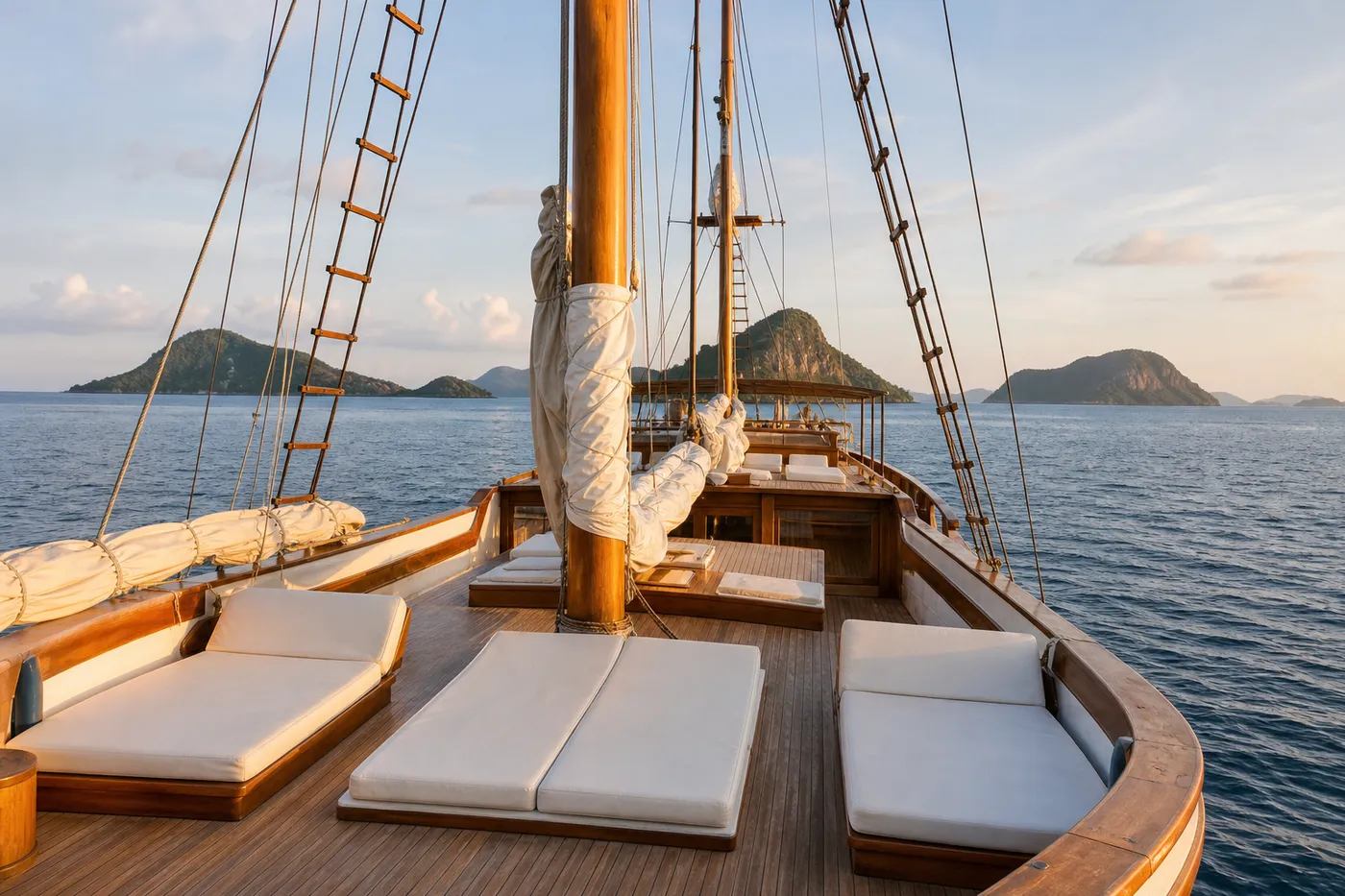
Deck space is the thing nobody expects. A phinisi built on cargo lines carries far more open deck per guest than a purpose-built steel dive boat of the same length, because the hull was drawn for volume and stability rather than cabin count. A typical 40-metre charter phinisi sleeps 10 to 14 guests where a steel boat the same size might pack in 22 to 26. The result is a week in which you can always find a corner of teak to yourself: the bow cushions at sunrise, the shaded midship benches during the crossing, the aft deck for the post-dive debrief that slowly becomes dinner.
Cabins vary more than on any other class of boat, and this is where you should pay attention when comparing listings. The tradition constrains the outside of the boat, not the inside; behind the planking you will find everything from simple twin bunks with a shared shower to full-beam master suites with bathtubs and picture windows, particularly on the newer builds aimed at the charter market. Air conditioning is now near-universal. Hot water, individual climate control and proper mattresses are standard on anything sold as an upper-mid or luxury boat. What the tradition does give every cabin is wood: the hush of it, the smell of it, the fact that no two cabins on a handmade boat are ever quite identical. Guests either find that charming or they book a floating hotel next time. Most find it charming.
The crew deserve their own paragraph, because a phinisi crew is not quite like any other hospitality team you will meet. Many of the deckhands and captains working Indonesia's charter fleet come from the same Sulawesi and Flores seafaring communities that built the boats, and it shows in small ways all week: the ease with which someone goes up a mast, the anchor set on the first try in a current that would embarrass a lesser skipper, the fact that the man serving your dinner may also be the one who caught part of it that afternoon. Crews on the better boats run to a ratio approaching one crew member per guest once you count captain, engineer, dive team, chefs and deckhands. Meals are a genuine highlight, usually Indonesian-forward with Western breakfasts, cooked in a galley the size of a wardrobe and somehow better for it. Give or take the occasional crossing where the chef braces the stockpot with a knee, we have eaten more memorably on wooden boats than in most restaurants ashore.
There are honest trade-offs, and we would rather list them than have you discover them. Wooden boats flex and creak underway; light sleepers should pack earplugs for crossing nights. Stairs are often steep, ceilings in lower-deck corridors can be low for tall guests, and a heritage hull will never have the elevator-and-atrium feel of a modern expedition ship. Maintenance is constant and visible; you may well watch a crew member re-oiling the caprail mid-trip, which we consider a good sign rather than a flaw. A wooden boat that looks slightly, lovingly worked-on is usually a wooden boat that is being looked after.
Phinisi vs modern steel liveaboards: which should you book?
Both formats do the same core job, three or four dives a day in the best diving country on earth, so the choice is mostly about temperament. A steel or aluminium boat typically offers more cabins for the money, more uniform layouts, sometimes active stabilisers, and a more predictable hotel-like finish. The phinisi offers mass and quiet at anchor, extraordinary deck space per guest, and the not-small fact that the boat itself is part of the destination. On a steel boat you photograph the reef. On a phinisi you also photograph the boat, usually within an hour of boarding.
Our take, having run and dived from both: for the classic Indonesian routes, Komodo and Raja Ampat especially, the phinisi wins on experience and gives up very little on function. The dive deck, camera table, nitrox and tender operations on a well-run phinisi are indistinguishable from a modern boat's. Where steel earns its keep is on the roughest open-water routes and for divers who simply want maximum berth count and minimum romance. If you are torn, our comparison of what actually defines a luxury liveaboard in Indonesia goes deeper into how build quality, crew ratio and cabin count interact with price.
How to spot a good phinisi from the listing photos
Once you know what to look for, a boat's photographs tell you most of the story before you ever ask for a quote.
- Look at the sheer line. A genuine Bulukumba-built hull has a distinctive sweep, low midship, rising boldly at bow and stern. Flat, boxy profiles usually mean a converted cargo hull or a new build drawn for maximum cabins rather than seakeeping.
- Check the rig. Real rigging, booms, gaffs and sail covers mean the boat can sail. Bare poles mean the masts are furniture.
- Count the guests against the length. Roughly speaking, a 30-metre phinisi carrying more than 12 divers, or a 40-metre carrying more than 16, is prioritising volume over comfort. The best boats feel almost under-populated.
- Find the dive deck photo. A serious operation shows you tank racks, rinse tanks, a camera table and a proper tender. If every photo is a drone shot of the bow, ask why.
- Ask when she was last surveyed and refitted. Wooden boats live on maintenance. A proud owner answers this question in detail and usually with photographs; a vague answer is your cue to move on.
It is worth saying how often the boat itself becomes the thing people remember, because it catches guests off guard more than anything else about these trips. There is a recurring pattern: the non-diving partner books reluctantly, treats the week as a compromise, spends the first afternoon photographing the deck joinery, and by day three is asking the captain the name of every sail. On the last evening, anchored somewhere like Padar with the rig catching the sunset, it is the boat rather than the mantas that gets named as the favourite thing in Indonesia. Cargo carpenters in Tana Beru, it turns out, were building honeymoon suites all along; it just took a century for the market to notice.

Chartering a whole phinisi
Here is the arithmetic that surprises people: take a phinisi that sleeps twelve, fill it with your own family, dive club or wedding party, and the per-person price of a private charter often lands within touching distance of what twelve strangers would each pay for cabins on a scheduled departure. What changes is everything else. The itinerary becomes yours; linger a second day at a site that is firing, skip the one nobody loved, ask the captain for sails up on the afternoon crossing because your group would rather sail than get in a fourth dive. The boat becomes yours too, which on a vessel with this much deck is the difference between finding a quiet corner and owning all of them.
Charters are where the phinisi format makes the least compromise, and they are most of what the top end of the fleet now does. Families book them because kids and grandparents both have space to escape each other. Dive clubs book them because a group of twelve certified divers can run a far more aggressive site list than a mixed scheduled trip ever could. If the idea appeals, our pages on Komodo yacht charters and Raja Ampat yacht charters cover routes, group sizes and seasons, and the honest advice is to enquire eight to twelve months out for peak dates; the best hulls in the fleet are few, and they book deep.
Where to sail on one
Phinisi work every Indonesian route, but two pair especially well with the format. Komodo is the natural first trip: short hops between anchorages, dramatic topside scenery that rewards all that deck space, and departures year-round from Labuan Bajo, with the dry season from April to November usually offering the steadiest conditions. Raja Ampat, from November to March, is the long-haul masterpiece: glassy anchorages between karst islands where a wooden boat at rest looks like it grew there. Both are covered in depth in our guides to Komodo liveaboard itineraries and Raja Ampat liveaboard diving, and both are, not coincidentally, where most of the country's finest phinisi spend their seasons.
A phinisi rewards the traveller who cares what they are standing on. If that is you, choose a Komodo liveaboard for your first trip or a calm-season Raja Ampat liveaboard for the full postcard, and when you get in touch, ask us about the boat itself: who built her, where, and what she is made of. It is our favourite question to answer, and on a hand-built boat there is always a story. Selamat berlayar.